Englished and Recomposed for 5th graders by Ehab Shawky.
Tonight, I will tell you of a young traveler. A boy who traveled quarter the earth on camel backs searching for something special. Something very few people search for. Something only the wise would seek. Our hero was the son of a Persian mayor and landlord. His family lived in a small village in Esfahan. His people were magus peasants and merchants. If Salman wished, he would have led an easy calm life. He would have enjoyed the luxurious life his father secured for him. Yet, destiny held a different path for Salman. It was the path of truth seekers.
Salman’s father was the leader of his people. He loved Salman so much. He hated to send him on the simplest errands. Salman felt that his father treated him as fathers treated their little girls. Salman’s folks were Magus. The only place where Salman enjoyed some freedom was the temple. As such, he devoted himself to serving there until he became the temple’s custodian. Salman’s father owned a great estate. One day, he got occupied by a huge building he was constructing in the village. He summoned Salman and said, “Son, I’m occupied by this new building. I need you to take care of business in our estate today.” He gave Salman necessary tasks to do. Before Salman departed, his father said, “Don’t get distracted by work and stay there for a late hour. Don’t increase my worries. I swear I will forsake all duties and go search for you. Do you understand?”
Salman promised his father to carry out his mission and return as soon as possible. He left heading towards their estate. On the way there, he passed by a church. The sound of the prayers attracted him. He didn’t know much about other faiths or their adherents. His long stay at home veiled him from the world. Driven by youngsters’ curiosity, he walked in to see what those people were doing. He watched them as they prayed and he was impressed. He felt a deep desire to pray as they did. He thought, ‘These rituals are better than what we have in our religion.’ He stayed at church until sunset. He forgot all about his tasks. When Christians finished praying, Salman asked about the original land of their religion. They told him it was Sham.
Salman returned home. His father had already sent some servants looking for him. Salman said, “Father, I passed by people praying in a church. I found their prayers fascinating. I can assert that their religion is better than ours.”
The old man said, “O son, there is no good in that religion. Your ancestors’ religion is better.”
Salman said, “No, I swear that their religion is better.”
On hearing this, the old man feared that Salman would leave him and join the Christians. He put fetters on his feet and locked him up inside the house. Salman managed to send a servant to the Christians. That servant informed them that Salman had embraced their religion. He asked them to send word to Salman if a caravan arrived from Sham.
A while later, a caller passed by Salman’s village. He declared that a caravan was departing to Sham. Salman managed to free himself from his fetters. He hid amidst the travelers and escaped with the caravan to Sham. That was Salman’s first time to leave his hometown. A trip from Persia to Sham at that time took weeks. For a teenager, that was a great risk. Yet, Salman took that risk because he had already chosen his path in life. It was the path of truth-seeking. No words can describe how tiring, lonely, and frightening that path is. Nonetheless, our hero took it.
When the caravan reached Sham, Salman asked about the most learned man of Christianity. The people directed him to the bishop of the mother church in their city. Salman went to that priest and expressed his desire to stay with him. He offered his services to the man in exchange for learning from him about Christianity. The priest agreed. Salman lived with him for a while but found him unfaithful. That priest encouraged Christians to give alms and made them long for its reward from Allah. When they delivered any sum to the church, the priest held it back from the needy. He kept it for himself. He collected jars of gold and silver. He would check on them when he thought no one was awake in church. He would gaze at them for hours. Salman hated what that man was doing so much. He wished to leave but wasn’t sure where to go next. A short while later, the priest caught an infection and died. When his followers came to bury him, Salman told them, “That was a bad man. He ordered you to give alms and made you long for its reward. Yet, whatever you brought him, he kept it for himself.”
They asked, “Why should we believe you?”
He said, “I can show you where he hid your money.”
When Salman showed them where the priest hid the gold and silver, they were stunned. They pulled out seven full jars. People were furious. They refused to bury the hypocrite. They crucified his body to set an example for others. Later on, they appointed a new bishop for the church. Salman stayed with the man for a while. He found him truthful, faithful, and most renouncing to this worldly life. Salman loved that priest so much. He served him and learned at his hands for years. Then one day, the old man fell sick. Salman said to him, “I’ve been living with you for a while. You’re the most beloved person to my heart. To whom would I go if anything happens to you?” The old priest said, “O son, very few still follow my path. Most people have gone far astray. There is an old friend of mine who lives in Iraq. He is faithful to the true path. If I pass, go and stay with him. May you be blessed.” The old man gave Salman his friend’s name and address. A few days later, he passed away. Salman attended to his teacher’s funeral and buried the man himself. After that, he made the necessary preparations and traveled to Iraq. He reached the priest his late teacher told him about. He told the man his story and asked to stay with him and learn at his hands. The old man accepted and Salman stayed with him.
Salman found the Iraqi priest as pious as his late friend. He found solace in his company after losing his past mentor. Yet, destiny had other plans for Salman. Shortly after he moved in with the Iraqi priest, the old man fell ill. Salman nursed the man. When it became evident that the man wasn’t going to survive, Salman said to him, “Before he passed, your friend advised me to join you. I obeyed his instructions and found solace in your company. But now, I see what has befallen you. What do you advise me to do?”
The old man said, “I know no other man who still holds on to our path but one. He lives in Nisibin. Travel to him. Tell him I sent you.” The old man gave Salman his friend’s name.
After the Iraqi priest passed away, Salman buried him. A few weeks later, he traveled to Nisibin. He went to the man and told him his story. The Nisibian priest allowed Salman to stay with him. Salman found him, too, following the path of his predecessors. He stayed with him and continued to learn about the old scriptures. A couple of years later, the priest’s health deteriorated due to old age. Salman asked him to whom he should go if something happened to him. The old man told Salman to travel to Amorium in Byzantium. He gave him the name of a pious priest there and advised him to join the man.
Later on, the Nisibian priest died. Salman buried him and traveled to the priest of Amorium. He told him his story and the man accepted to let Salman stay with him. Salman found him following exactly the path of his former friends. By that time, Salman had grown to become a fine man. He worked and earned his living at Amorium by rearing cattle and sheep. Within a few years, he gathered a fortune. His honesty and truthfulness made him reputable among the herders. But then again, age got to the Amorium priest. On his deathbed, Salman asked him, “To whom should I go if you join your pious friends?”
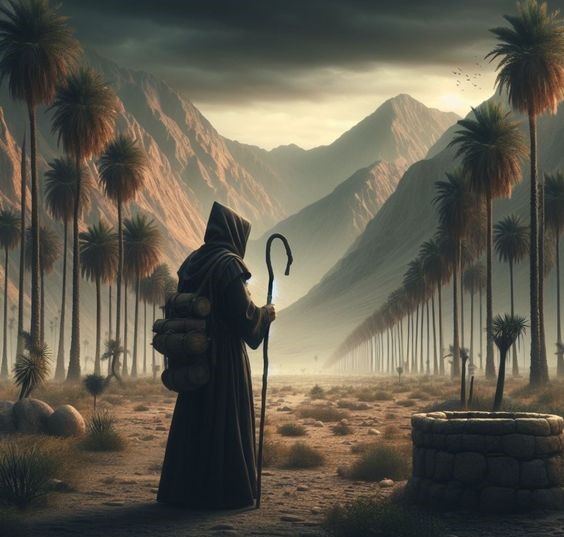
He said, “O son, I know no one still holding on to our path. Yet, listen to me carefully. I believe this is a prophetic epoch. A prophet will soon appear in Arabia. He will escape to a forest that lies between mountains. It’s a place full of palm trees. He will preach the pure creed of Abraham. He has some personal signs: He takes no alms to himself but accepts gifts. Between his shoulders, there will be a sign on his skin. Travel to Arabia. If you find such a place, wait for his appearance there.”
After the Amorium priest died, Salman felt tired. He had been traveling for years. He had acquired vast knowledge and learned how to worship his lord properly. As such, he decided to stay at Amorium. He stayed there and attended to his business for a few years. Then one day, some traders passed by him. They were from Banu-Kalb tribe in Arabia. Salman felt it in his heart that Allah is ordering him to follow his late friend’s advice. He said to the Arab traders, “If you take me with you to Arabia, my cattle and sheep are yours.” They agreed, so Salman gave them his flock and they took him with them. When they reached Wady Al-Qura in Arabia, they double-crossed Salman. They tied him and sold him as a slave to a Jew. Salman saw many palm trees in that valley. He hoped it would be the place the Amorium priest described. He stayed with his Jewish master for a while. Then one day, his master’s cousin from Bani-Quraiza tribe came visiting. He bought Salman and took him to Madinah. The moment Salman’s eyes fell on this new land, he was thrilled. It was exactly what his late friend had described. Salman stayed with his new master and worked for him for years. Although he was a free nobleman, he accepted to live as a slave. If that was the price he had to pay in the path of truth-seeking, he was willing to pay it.
One morning, Salman was working atop a palm tree. His master was sitting underneath when one of his cousins passed by. That cousin said, “May Allah kill those Arabs. They are gathering at Qibaa’ around a man who came fleeing from Makkah. They claim he is a prophet.”
On hearing this, Salman quivered. He almost fell on his master. He climbed down and asked the man, “What are you saying? What’s the news?”
His master gave me a nasty punch and said, “What have you got to do with this? Return to your work.”
Salman said, “Nothing. I just wished to know if what your cousin said was true.” He then returned to his work but his mind was somewhere else.
By nightfall, Salman took his share of dates and set out towards Qibaa’. He was seeking to see the prophet and test his qualities. When Salman arrived at Qibaa’, he found the prophet sitting with some of his Companions. Salman walked over to him and said, “I learned that you and your friends are strangers seeking refuge. I brought you some dates. May Allah accept it as alms. I think you deserve it the most.” Salman laid down the dates before the prophet. The Prophet placed it in front of his Companions and said, “Eat.” Yet, he abstained and didn’t eat from it. Salman said to himself, ‘This is the first sign.’
Salman returned to his master’s home. For a while, he saved more dates and bread. During this period, the prophet moved to the inside skirts of Madinah. Salman went to him with what he had gathered and said, “I saw that you don’t eat from alms. This food is a gift for you. Will you accept it?” The prophet accepted the gift. He ate from it and ordered his friends to eat with him. Salman said to himself, ‘This is the second sign.’
Later on, Salman looked for the Prophet. He found him resting with his companions. They were building the mosque at that time. The prophet was wearing a split garment throwing one half on each shoulder. Salman greeted him and lurked around trying to peek at the upper part of his back. When the prophet sensed what Salman was trying to do, he threw the garment off his shoulders. Behold, the seal of prophethood was clear as the Christian priest described it. Salman staggered towards him. He kissed his head and wept in disbelief. The prophet calmed him down and asked about his story. Salman sat before the prophet and his companions. He told them his story. On hearing it, the prophet ordered him to be patient.
Enslavement held Salman back from attending the battles of Badr and ‘Uhud. One day, the prophet summoned Salman. He told him, “Write a pact of emancipation with your master, Salman.” Salman followed the prophet’s order. His master agreed to free him if he cultivated in his barren lands 300 palm trees and gave him 40 ounces of gold. Salman informed the prophet of this pact. The prophet said to his companions, “Help your brother,” and they did. One companion brought 30 baby palm trees. One brought 20. Others brought tens of baby palm trees. When Salman gathered all 300, the prophet told him, “Go Salman. Dig their plantation places. When you finish, I will put them in their places myself.” Salman dug their plantation places with the help of the companions. When they finished, Salman informed the prophet. The prophet went with Salman. The companions handed him the baby trees one by one. He planted all 300 palm trees with his own hands. Salman said about this incident, “I swear, not one of them died.”
By this, Salman fulfilled the first part of the pact. There still remained the 40 ounces of gold. Not long after that, the prophet received a piece of gold equal in size to a hen’s egg. He asked his companions to summon Salman. He said, “Take this Salman, and fulfill the rest of your debt.”
Salman said, “This is a little piece compared to my debt, O prophet?”
The prophet said, “Take it, and Allah will fulfill your debt.”
Salman took the golden egg and went over to his Jewish master. He broke part of the egg and weighed it. It weighed heavier than it looked. He broke a second part and it covered more of his debt. Salman said, “I swear that all the 40 ounces were fulfilled from the small golden egg the prophet gave me.” Salman was a free man again. After that, he never missed an event with the prophet.
During the Confederates’ attack on Madinah, Salman advised the prophet to dig a trench at Madinah’s entrance. This plan helped break the idolaters’ attack. It helped save Muslims from defeat. On that day, Muslims competed among themselves to take Salman into their households. They competed to honor the man whose plan helped save their city and their families. Then the prophet said, “From now on, Salman is a member of my own family.” No other companion was ever given such an honor. Salman died after the prophet passed away by about 22 years during the reign of ‘Uthman Ibn Affan. What an honorable journey. May Allah’s blessings be upon Salman for striving through this long path. May Allah reward him for his patience in seeking the truth. May Allah be pleased with him. Amen.
Discover more from Islamic Methodologies Made Easy
Subscribe to get the latest posts sent to your email.
 Islamic Methodologies Made Easy