Many preachers mix politics with Islam; they seek to drive people towards a certain political direction which have come to exist under the name Islamism. Islamists claim that they want to apply the Islamic Shari‘ah through today’s legitimate political channels. Let’s go back to the beginning, discuss the matter reasonably, and try to assay the ideology of these groups according to what Islam teaches.
The famous scholar Abu-Al-Wafa’ Ibn-‘Uqail (431-513 A.H.) said: “Politics is every decision taken seeking to improve people’s lives and fight corruption, even if it were a decision that the prophet P.B.U.H. never took nor is there any injunction in the Qur’an referring to it. Whoever says: ‘There is no politics except for the matters that the Shari‘ah has tackled’ is surely mistaken and claiming that the companions were innovators.”
Prophet Muhammad was not a politician, a congressman, an ambassador or a minister. He never held any of those positions. He never sought after them among his tribe Quraish though they all existed in some fashion during his time. He never gave any fancy political speeches throughout his life, nor did he ever claim to be a politician. When he was offered by the polytheists of Makkah to be declared as their king in return for waiving the preaching of Islam, he refused and said, “If they were to put the sun in my right palm and the moon in my left, I shall never stop preaching Islam till I see it prevail or die trying;” and he insisted on preaching his message in the face of persecution, insults, social boycott, poverty, hunger, brutal physical assaults, and being targeted to kill by most Arabs. For this reason, he became the best preacher ever.
After 13 years of preaching Islam, the prophet migrated to Madinah. By that time, the majority of the community there had already embraced Islam. They believed in him to be a messenger from their Creator, so they obeyed him more than they would have done with any king. Consequently, any worldly life problem or complaint was automatically raised to the prophet P.B.U.H. This is why—during this stage—his prophethood took the shape of a political position. Back then, the number of people in Madinah was very few and so were their needs and problems. Through his sincerity and modesty, he succeeded in handling the political issues in an astonishing democratic manner at a time when the earth hadn’t known yet the meaning of democracy, but only knew monarchy.
When companion ‘Odai Ibn Hatem narrated the story of his faith, he described the prophet saying: “I travelled seeking to meet the prophet at Madinah. When I arrived, I found him praying in the mosque. I entered and greeted him. He looked at me and said: ‘Who is the traveller?’ I answered: ‘ ‘Odai Ibn Hatem.’ He got up welcomed me and held my hand inviting me persistently to his house. On the way there, a very old weak woman called him by his name. He stopped and kept on listening to her demands for a very long time. I said to myself: ‘I can swear that this is not a king.’ When she finished, we went along. When we entered his house, he picked up a pillow made of leather stuffed with arum, and handed it to me saying: ‘Sit on this.’ Noticing it was the only one inside the room, I said: ‘No, you sit on it.’ But he insisted saying: ‘No, but you sit on it,’ and he sat on the floor. Seeing this, I said to myself: ‘I swear that this could never be the condition of a king.’ [Recorded by Ibn Ishaq, Ibn Hisham and others]
Hence, the prophet did not come to teach any of the political sciences which we know today, but he was sent to educate each and every human being, whether a king, a politician, an engineer, a doctor, a nurse, a scientist, a husband, a servant, a farmer, etc., about the Creator of this universe, and how to be a truthful sincere servant to Him, whether you are a president or a peasant.
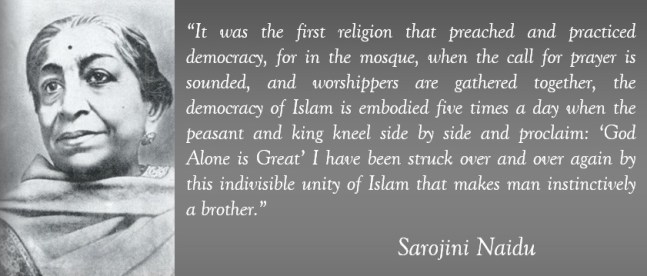
What’s truly amazing is that some non-Muslims understand this easily when they read about Islam, while some Muslims don’t. Sarojini Naidu, The famous poetess of India said:
Emirate or governorship is not a desirable position in the prophet’s teachings. On the contrary, it was recorded by Bukhari and Muslim that two men entered on the prophet and said: “Instate us as governors O prophet.” The prophet P.B.U.H. replied saying: “We (Muslims) do not instate those who seek governorship or are desirous of it.”
They also recorded that Prophet Muhammad P.B.U.H. said: “He who seeks after emirate does not receive aid [from Allah] when instated, but he who is instated without seeking after it shall receive Allah’s aid.”
Abu-Hurayrah reported that the prophet P.B.U.H. said: “Verily you shall be keen on emirate and on the judgment day it shall be a great remorse.” [Recorded by Bukhari]
The prophet described emirate saying: “It’s a trust, and in the hereafter, it shall be a disgrace and remorse.” [Recorded by Bukhari]
Allah orders us to improve people’s lives and preserve it, each and every person according to his or her capacity. The sweeper who cleans the streets is doing this according to his capacity, the physician who treats those who are sick is doing this according to his capacity, the wife who raises good children and takes care of her husband is doing so, the ruler who promulgates fair laws is doing so, etc. All of the previous in the general sense of the word is from Islam, but there are no specific injunctions in the Shari‘ah tackling the means and measures that should be taken to fulfil any of those tasks in the best manner. For instance, when ‘Omar established the judicial and postal systems as a Caliph, he was not following any prescribed laws in the Shari‘ah, this was common sense, it is something which people’s lives needed to go on in an upright manner. The simple man whom Prophet Muhammad praised for cutting down a tree that narrowed the people’s road did not follow a certain injunction in Shari‘ah. Shari‘ah orders us to do what’s right and beneficent and to fight corruption and what’s harmful wherever we may be.
Think about any of the mentioned examples, do we actually need revelations from beyond the boundaries of the universe in order to carry them out. These are matters of common sense, they don’t need a rocket scientist to deduce their necessity. What’s the use of being created having this fascinating mind if you are going to halt its utilization and insist that you need divine revelations in order to act in worldly life matters?! The prophet P.B.U.H. said: “You are more aware of this worldly life affairs and their disposal.” Politics is the system through which worldly life affairs could be maintained properly. And because it’s a matter of worldly life, Islam never prescribed a certain way for practicing it, nor did the companions agree on a certain fashion for practicing it after the prophet’s departure. Each and every one of the rightly guided Caliphs had his own manner of governorship. Each one of them followed a different path in instating governors and observing their performance. Each one of them followed a different path in responding to people’s complaints based on the situation at hand. The examples are endless here. Likewise, Islam doesn’t teach Muslims how to reclaim the desert, it doesn’t utter a word about how to cultivate wheat or cotton, nor does it speak of how to build up factories or develop modern technologies; there is no mentioning whatsoever of how to develop a remedy for encephalitis, carditis, hepatitis, etc. I can have a field day with this issue. What Islam orders us to do is to seek avidly after knowledge, preserve this earth and remember our Lord’s perfection for everything in each and every act we carryout.
Near the end of his life, Caliph ‘Omar Ibn Al-Khattab invoked Allah saying: “O my Lord, the number of my subjects has increased vastly, and my ability to fulfill their needs is getting weaker, so please pardon me and let me return to you without being negligent or disregardful.”
It is extremely important to understand those words, if the people’s number is few, it is easy for one man to fulfill their needs and respond to their complaints; but as this number increases, this task needs more and more men to fulfill it. Example: when the number of people increases, the need for more cultivated lands to produce enough crops shall ensue. If the increase continues, the need to reclaim the desert lands shall evolve and consequently shall the need for specialized agricultural engineers and modern agricultural machinery. This shall entail the need for specialized mechanical engineers, etc. The planning and coordination between all of these disciplines, solving their problems, and providing them with their needs entail the need for governmental employees dedicated to handling such issues. Employees need intelligent managers to handle each and every department of service required by the people, those managers are the ones we call ministers. Ministers must be supervised by a chief minister who coordinates the cooperation between them all and reports all matters to the head of the state. This head of the state must be capable of managing matters of politics and war; he must take care of the people’s needs and reform their lives while protecting them from any enemy.
Therefore, the knowledge and ability of religious scholars in solving people’s problems stand ineffective in modern times because solving those problems is not a matter of religion alone, but it’s a matter of science, invention, research, development, homeland security, and so many other things that need a team of people from different academic backgrounds to work together and contribute in handling things. What scholars should do besides teaching people about their religion is to investigate what the people need and preach its implementation. They should educate the youths about the importance of these tasks, and encourage them to learn and become highly educated researchers and inventors who can serve their community. Reclaiming the desert has become incumbent, so it is an Islamic obligation that scholars incite its implementation. Treating people’s pains and maladies is something necessary, so it is an Islamic obligation on preachers to urge researchers find remedies. Establishing factories that produce the necessary utilities we need in our lives is something essential, so it is an Islamic obligation that preachers instigate engineers to build those factories, etc.
The previous are necessary acts that could not be undertaken by politicians, sheikhs or jurists. Only those who are specialized in such fields can carry out such missions. It is the politician’s duty to support, plan and facilitate the task for specialists, and secure the supplement of all their needs. It is the scholar’s duty to make investigations about people’s needs, incite their fulfillment, and invoke Allah to grant the specialists success in what they are doing. No scholar should forsake remaining close to the people and educating them about their religion to practice politics, nor should politicians ascend the mosque’s pulpits and speak about religious rites and rituals. Scholars call for reform and incite it persistently, politicians plan and facilitate the means of its implementation, and specialists carryout the task.
If the previous three figures work together for the sake of reforming people’s lives, then they are preaching Islam without uttering a word from the Qur’an or the Sunnah, they are actually living the Shari‘ah. If they decline and tear up the community amongst each other, they are all traitors to Islam and to their countries, and should be taken to court. In my opinion, specialists carry 75% of the load upon their shoulders all the time, but they are never appreciated for it, especially in the Arab countries. This is why many of the youths renounce seeking after knowledge, and follow the fancy famous sheikhs and politicians who have torn our communities between them.
In my country Egypt, many streets, squares and bus-stations are named after army officers, politicians and rulers, even some streets are named after notable sheikhs, but not one street named after a scientist, a doctor, or an engineer. Even the engineers who rebuilt the Egyptian army after the relapse of 1967 have no mentioning whatsoever. By all means, the country that doesn’t appreciate its knowledgeable citizens shall never prosper or find any light in its future.
Back to mixing preaching Islam with practicing politics; if you wish to practice politics with the intention to reform people’s lives, then be my guest, but don’t lie to the people and claim that there is a certain prescribed Islamic way for practicing politics. Don’t make underground schemes to smear the reputation of any governor who doesn’t belong to your group and use Islam as your ride to reach the leading position. Don’t be a traitor and take foreigners as allies against the citizens of the country. We have all seen the performance of those who raised the banner of reformation in the name of Islam ever since the ‘Abbāsids and till the moment of writing this. Never were any of them truthful or sincere. Muslims have always followed anyone for uttering the word Islam or Muhammad amidst his speech. They don’t realize that their desire for the justice of Islam could only be fulfilled through their own practice. No one can repair your heart if you don’t criticize yourself and repair your intentions. No one of those Islamists has a magic stick with which he can cast a spell on you and change your life. No one is going to defend the weak ones by empty speeches and fancy conferences. Unless you change yourself nothing will ever happen.
Prophet Muhammad’s approach in preaching Islam was not built upon seizing power or practicing politics. It was built upon raising sound pious hearts, and planting the sense of justice, equality and fraternity among all people. If any nation, tribe or even a small bunch of people succeed in reaching such a state, surely they shall prosper and be able to accomplish anything. Preaching Islam according to my understanding is to raise sincere, well educated, pious persons with sound hearts; only then shall the state of justice which all believers dream of be established.
IMME, ISBN:9789779027395
Written By: Ehab Shawky
Discover more from Islamic Methodologies Made Easy
Subscribe to get the latest posts sent to your email.
 Islamic Methodologies Made Easy
Religion and politics should never mix. Very nice written.
LikeLiked by 1 person
Intelluctually balanced and was a very informative read.
LikeLiked by 1 person
Thank you, Asma. I’m glad you liked it.
LikeLike