WARNING: This post may include images not suitable for minors. If you are under 18, kindly have enough courtesy to close this page immediately. In this post, I compiled a brief record for the history of the sons of Israel, and related it to the development of Zionism.
According to the Jewish transmitted chronicles: After a series of tragic dealings with mankind, starting with Adam’s sin and expulsion from paradise… reaching Noah’s flood, God decided to chose one man and his descendants to be the trustees on his messages, and from among them, all messengers to mankind shall be chosen. Their duty was to abide by God’s messages, and in return, God would grant them his protection and victory. This was a covenant between God and Abraham, the chosen pious man. After Abraham died, this covenant was renewed with his son Isaac, then with Isaac’s son Jacob (AKA Israel), then with the 12 sons of Jacob. These 15 figures are known in the Jewish traditions as “The Patriarchs”. Levi was one of the 12 sons of Israel, from his offspring came Moses, the true founder of Judaism. He is the first bearer of a message from God to the sons of Israel. This message included the commandments around which Judaism revolved. The message was named the Torah. It consists of 5 books usually referred to by the name “Pentateuch”.
God’s covenant with Abraham included a promise to grant him a great nation that would dwell in Canaan. Through the course of history, the sons of Israel had to immigrate to Egypt escaping a famine that hit Palestine, and in Egypt, they were enslaved by the Pharaohs for almost 430 years. During this period their numbers multiplied vastly from a few tens of persons to hundreds of thousands. This made Pharaoh issue a decree that stipulates the killing of any newborn child for the Israelites. Moses was among the children born in this period, but god saved him in a miraculous manner, and he was raised and protected by Pharaoh himself. When he was 40, an incident happened that changed the history of mankind until the moment of writing this. Moses saw 2 men fighting, one of them was an Israelite and the other was Coptic. Trying to defend the Israelite, he punched the Coptic, accidentally killing the guy. The Bible tells this story in the following few sentences: “And it came to pass in those days, when Moses was grown, that he went out unto his brethren, and looked on their burdens: and he spied an Egyptian smiting an Hebrew, one of his brethren. And he looked this way and that way, and when he saw that [there was] no man, he slew the Egyptian, and hid him in the sand.” Anyway, this incident forced Moses to escape from Egypt towards Midian where he lived in exile for 40 years working as a shepherd for Jethro. One day, while travelling between the mountains with his herd searching for pasture, it happened that he received god’s orders telling him to lead his people out of Egypt.
After many dramatic events, Moses succeeded in leading the Israelites into the wilderness of Shur, then into the wilderness of Sin, where God inspired Moses to ascend Mount Sinai, and there he received the tablets which included God’s message to the Israelites. Moses received laws governing every aspect of life in that day. Based on these laws, the Mishnah and the Talmud were later on compiled. During the years of wandering, Moses and Aaron died, and it was Joshua, Moses’s minister, who led the Israelites into Philistine. Later on, Solomon established a huge temple for YHWH in Jerusalem. His father David wanted to do this, but he was forbidden because he shed a lot of blood. The Ark of the Covenant was placed inside the temple, and a group of priests assumed the responsibility of serving YHWH’s temple.
922 B.C.: Solomon’s death and the split of the Israelites into 2 nations. The northern one was called Israel. It included 10 tribes of the 12, consequently, they were larger in number and more productive. The southern nation consisted of the remaining 2 tribes Judah and Benjamin. These 2 nations fought against each other seeking to seize full control. The war between them extended for years, the book of Chronicles (13:17) mentions 500,000 men from Israel being slain by Judah. This was mainly because the northern nation was also attacked by the neighbouring countries during its war with Judah.
800-700 B.C.: The 8th century witnessed a huge prophetic movement during these troubled times. Hosea, Isaiah, Micah and Amos were 4 famous prophets who lived in this century. They gave prophecies about Judah, Jerusalem, future prophets, etc… Their role was mainly reformatory, they criticized the sins of the Jewish community and the social injustices of their time in a poetic style. Some of them lived during the Assyrian invasion in 721. During this century, the “Elohist text” was compiled.
721 B.C.: Year of the Assyrian invasion to the Northern nation “Israel”. The invasion resulted in complete destruction of the 10 tribes.
620 B.C.: War erupted between the Chaldeans (Babylonians) and the Assyrians. The Chaldeans eventually won the war after many years. Prophet Habakkuk lived during this war.
586 B.C.: The Babylonians invaded Judah after gaining triumph over the Assyrians. The temple was destructed, and the Ark of the Covenant was destroyed. The Jews fell in captivity. Afterwards, they were deported to work as slaves in Babylon. It was Ezekiel who led the Jews while in captivity. His role was important in preserving the identity and customs of the Jews. His students were the ones who compiled the “Sacerdotal text”. The Diaspora began with the destruction of both nations. Synagogues also began as an assembly of at least 10 men (Quorum) and a copy of the Torah with them. Rabbis or masters was the title given to those who studied the scripture and taught it to people.
538 B.C.: Cyrus the great of Persia invaded Babylon, destroyed its idols and freed the Jews as was predicted by Isaiah. Among the Jews who were freed later on was Prophet Ezra. The Jews who returned to Jerusalem reestablished the temple in 520 B.C.
70 A.D.: Destruction of the second temple by the Romans. Jewish revolutionaries were slaughtered, thousands were enslaved and the Diaspora was renewed. Jews of the Diaspora separated themselves from the gentiles by refusing to work on the Sabbath, refusing to eat prohibited kinds of food, practicing circumcision, etc… The rabbis sought by laymen, faced a huge problem in applying the laws of the scripture in countries ruled by non-Jews, but the people gathered around their knowledgeable ones. “Yohannah Ben Zakkai” was one of those rabbis, he was living in Jerusalem during the siege, and he managed to escape to Titus’s tent one night to ask his permission to gather the rest of the rabbis and discuss the future of Judaism. Titus agreed and those rabbis assembled, their discussions continued for years. Among the results of their councils was the formation of the canon which we know today as the “Old Testament”. After the destruction of Jerusalem, Jews moved to Galilee.
135-217 A.D.: “Judah Ha Nasi” who was one of the most important rabbis in the Jewish history, compiled the commentary of the Jewish scholars on the laws of Moses since the time of Ezra. He called it the “Mishnah”. It was published in 200 A.D. as the oral Torah. It included the debates between the 2 most famous schools of thought in Judaism, the Hillel school and the Shammai school, what they agreed on and what they differed about, it also included the opinions of the famous rabbis like Rabbi Akiva (died 137 A.D.). The oral Torah or the secondary law was a means of preserving the primary laws of the Torah and making their understanding and application easier for the Jewish people.
600-1000 A.D.: Rabbis who had compiled the Talmuds were succeeded by scholars who established schools and ran academies teaching the Talmud. The dean of the academy was called “Gaon”. This period was called the Gaonic period. Another group named the “Karaites” rose against the Gaons and denied their authority and that of the Talmud. They only accepted the Hebrew Bible (Old Testament). This period also witnessed the compilation of “Sepher Yetzirch” or the “Book of Creation” by the Babylonian scholars. It contributed in the evolution of “Kabbalah”.
750 A.D.: The ‘Abbās id Caliphate rose in Iraq. They showed tolerance towards the Jews of Babylon who mingled with the Arabs and Muslims. This continued for almost 200 years and Jewish academies flourished in Baghdad.
882-942 A.D.: “Saadi Ben Joseph”, the last great Gaonim who was the leading spokesman against the Karaites, translated the Hebrew Bible to Arabic. Later on, the struggle among the Jewish sects became more intense, gradually the academies declined and closed their doors. The leaders of the Jews passed through the Islamic states safely and freely till they reached Spain where they were allowed to enter the fields of government, science, medicine, philosophy, etc… The most famous Jewish philosophers and Talmudists were living in Islamic states. With the decline of the Babylon community, Spanish Jews became the leaders of the Jewish world. Among them were:
Samuel Ibn Naghrillah (993-1056): The Grand Vizier of Granada.
Judah Ha Levi (1075-1141): A physician and poet.
Moses Ibn Nachman (1195-1270): Nachmanides was a Talmudist, Kabbalist and philosopher.
Moses Ibn Maimoun (1135-1204): Maimonides was a physician, Talmudist and philosopher. He escaped from Al-Mohad’s persecution to Egypt where he became Saladin’s personal physician. His most famous books were: “Mishnah-Torah”, it was a summary of the Talmudic laws, and “Guide to the Perplexed”, which was an attempt to harmonize Judaic creed with Aristotle’s philosophical views. This book was criticized greatly by the rabbis and Talmudists of the time.
1096 A.D.: Beginning of the Crusades by the orders of Pope Urban II.
1280 A.D.: Vast Persecution campaigns were launched against the Jews forcing many of them to escape to Poland and Turkey. Approximately 160,000 Jews lived in Poland, Ashkenazim was the name given to them. They spoke “Yiddish”, which is a combination of German and Hebrew. About 500,000 Jews lived in Turkey, Sephardim was the name given to them. They spoke Spanish with some Hebrew. Meanwhile, a Spanish scholar named Moses De Leon compiled “The book of Splendor” named “Zohar”. He attributed part of the book to Simeon Ibn Yohai, the student of rabbi Aquiva who lived in the 2nd century. This book replaced the Talmud and became the most widely read book in Judaism. The Kabbalistic literature addressed the oppressed who have little hope. This is why it was sought by most Jews, especially after their expulsion from Spain in 1492.
1290 A.D.: Expulsion from England.
1306 A.D.: Expulsion from France.
14th century: Expulsion from Germany.
1391 A.D.: Thousands of Jews massacred by European Christians.
15th century: Expulsion from Spain, followed by Portugal.
1492 A.D.: Ferdinand and Isabella expelled Muslims and Jews from Spain.
1520 A.D.: Martin Luther started preaching Protestantism. First he denounced the Catholic Church and its persecution campaigns against the Jews, but when Jews refused his version of Christianity, he turned against them. In response to his views, the Catholic Church made some reformations that were accompanied with the inquisitions and the formation of the Ghettos (These were confinements in which Jews were forced to live).
1648-1656 A.D.: Persecuted Cossack Peasants led a revolution against the Polish nobles. They directed their anger towards the landlords and tax collectors who were mostly Jews. Many were slaughtered, women were raped, etc… Around 100,000 Jews were killed in this revolution, the survivors fled to Western Europe.
1789 A.D.: The French revolution, followed by the declaration of human rights and the tearing down of Ghettos.
1881 A.D.: The assassination of Alexander II, the Russian Emperor and the Emperor of Poland and other eastern countries. This resulted in new pogroms against the Jews. Thousands fled to U.S.A.
1894-1899 A.D.: The Dreyfus case: Captain Alfred Dreyfus was accused of committing treason against the French army. He was convicted falsely and sentenced to be imprisoned for the rest of his life. 7 years later, his trial was declared erroneous. This case was covered by an Austrian Jewish journalist “Theodore Herzl” who concluded that: “Regardless of the liberal façade of Europe, Jews would never be treated fairly until they have a land of their own. Herzl started a movement that pleaded the cause of a Jewish state. It was called “Zionism,” and it chose Palestine as a place for this dream.
1900 A.D.: Jews started buying lands in Philistine (AKA Palestine).
1909 A.D.: The foundation of Tel Aviv.
1917 A.D.: Balfour declaration to Chaim Weizmann.
1920 A.D.: 50,000 Jews settled in Palestine.
1928 A.D.: 100,000 Jews settled in Palestine.
1931 A.D.: 175,000 Jews settled in Palestine.
1933 A.D.: 220,000 Jews settled in Palestine.
1935 A.D.: Hitler issued new laws reducing Jews to second-class citizens. They could not vote, hold office or work in most professions.
1941 A.D.: The Holocaust started. Over 3 million are claimed to have been annihilated. The number is not solid. Many sites would say 5.9 million. The Main reason behind the holocaust was the troubles that faced Germany after WW-I, they blamed the Jews for their defeat. The “Protocols of the elders of Zion” was believed to play a big role in this. [In his book “The Founding Myths of Israeli Politics,” Roger Garaudy, the French Philosopher, pointed out that the number of Jews who lived in Europe during World War II did not exceed 3.5 million – so where did the [figure of] six million come from. He explained that the Israeli government was using “the holocaust” as a “justifying dogma” for its actions in Palestine and toward Palestinians]. Either way, Europeans persecuted and killed Jews; the question that should arise in one’s mind is why the hell are the Palestinians forced to pay the price?! I guess what’s beneath the surface in this issue is way much bigger than what most simple people and laymen think.
1947 A.D.: The United Nations voted for a partition plan for Palestine though the Jews only owned 2% of Palestinian lands. Palestinians refused this decision which led to an unresolved situation till the moment of writing this. Most importantly, it led to the transformation of Judaism from a religion to Zionism as an ideology. Accordingly, Palestine was divided between the natives who have been living there for centuries on one hand (including Jews, Christians, and Muslims), and “Zionists” on the other. Zionists claim that all the land between the Euphrates and the Nile is theirs as promised by YHWH, the god of “Israel.” They even made their flag a symbol of this theme: the two blue lines indicate the two rivers, and David’s star amidst them indicates the big Israel of their dreams.
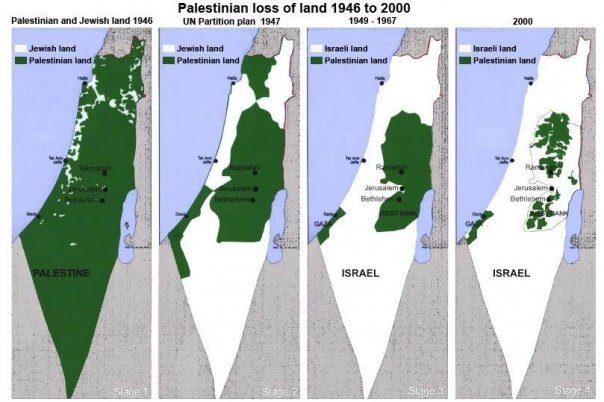
The Zionists’ crimes against Palestinians
In order not to forget, from between hundreds of massacres, this is a very simplified quick view of the Israeli massacres in Palestine, the number of martyrs, and the places of the incidents are listed.
Massacre of the town of Sheikh 31/12/1947
Haganah gangs stormed the village of Sheikh town (today called Tel-Genan) and chased the unarmed citizens, the massacre has led to the deaths of many women and children, the death toll reached approximately 600 people. Most of the bodies were found inside the homes of the village.
Massacre of Deir Yassin, 10/4/1948
Jewish gangs: Stern, Irgun and Haganah raided the village of Deir Yassin, west of the city of Jerusalem (based on its ruins is today’s Israeli settlement called Givat Shaul) at two o’clock in the morning, and proceeded to kill all living souls in the range of their weapons. After that, they kept on throwing bombs inside the houses of the village to destroy them over whoever was inside, for the orders issued to them required the destruction of all houses of the Arab village. At the same time members of the Irgun and Stern gangs walked behind the exploded houses killing those who remained alive. The massacre continued until noon, and before withdrawal from the village; the surviving people of the village where gathered in front of the walls and executed by shooting. 360 Palestinians, mostly elderly, women and children; were martyred. Menachem Beigin sent a telegram of congratulations to Irgun’s local commander “Raanan” saying: “Congratulations to you for this great victory, and tell your soldiers that they made history in Israel.” In his book entitled “Revolution” Menachem Beigin says: “The massacre of Deir Yassin contributed with other massacres in emptying the country of 650,000 Arabs.” He added: “Without Deir Yassin’s massacre there wouldn’t have been Israel.”
Massacre of the village of Abu Shusha 14/5/1948
The massacre began at dawn in the village of Abu Shusha, near the village of Deir Yassin, 50 martyrs of men, women and children were killed, many were hit in the heads with axes. The soldiers of the Kiryati Brigade, who carried out the massacre under general Djafaty’s leadership fired on anything that moves without discrimination.
Tantura massacre 22/8/1948
In the night between 22 and 23 May 1948, battalion 33 of the Alexandroni brigade (which was called back then the “Battalion Saturday,” because they were assigned with a new task at each end of a week, during the War of 1948) attacked the village of Tantura, occupied the village after several hours of the towns’ people resistance, and in the early morning the entire village fell into the hands of the occupation forces. The Israeli soldiers engaged for several hours in a fierce bloody hunt for adult men to kill them. They initially opened fire on them everywhere; in the houses, the squares and even in the streets. After that, firing was concentrated in the village cemetery. The massacre left more than 90 martyrs who were buried in a large mass grave in the cemetery of the village that was later held as a parking lot serving “Dur” Beach on the Mediterranean Sea, south of Haifa. After 1948 about 700,000 Palestinians were expelled from their homeland by Zionists. There is a long list of Arab towns and villages depopulated during the 1948 war under the sponsorship of the western countries, which still continues until today.
Qibya massacre 14/10/1953
The units of the Israeli army surrounded the village of Qibya—on the day of the massacre with a population of about 200 people—with a force of about 600 troops. After intense artillery shelling that targeted the homes, the Israeli occupation forces stormed the village firing indiscriminately. While an infantry unit chased the unarmed Palestinian population and shot them deliberately, other units put explosive charges on some of the houses to destroy them above their residents. The occupation soldiers awaited outside in the streets during the preparation for the explosion, and shot all those who tried to escape from the houses being prepared for the bombing. The outcome of the massacre was the destruction of 56 houses, the village’s mosque, the only school, and the village’s water tank. 67 men, women and children were killed and hundreds others were injured. The commander of Israeli forces who carried out the massacre was Ariel Sharon, the previous Israeli Prime Minister.
Qalqilya massacre 10/10/1956
The Israeli occupation army and a group of settlers, attacked the village of Qalqiliya, located on the Green Line separating the Arab territories occupied in 1948 and the West Bank. A detachment of the army, a battalion of artillery and ten fighter aircrafts participated in the attack, the Israeli army bombed the village with artillery before storming in, more than 70 martyrs were the victims of the massacre.
Kafr Qasim massacre 29/10/1956
This village lies south of Tulkarm. 49 Palestinian civilians, men, children and women were killed during an attack by the Israeli army that first imposed a curfew in the village, the children and the elders launched to inform young men who worked in the agricultural land outside the village about the curfew, but the forces stationed outside the village proceeded to kill them in cold blood, they killed the young men returning prior to their arrival inside the village.
Massacre of Khan Younis, 3/11/1956
The Israeli occupation army carried out the massacre of the Palestinian refugees in the camp of Khan Younis, southern Gaza Strip, killing more than 250 Palestinians. After nine days of the first massacre 12/11/1956, a unit of the Israeli army implemented another massacre killing about 275 civilians in the same camp, and more than 100 other Palestinian residents of Rafah refugee camp on that same day.
Al-Aqsa Mosque Massacre 8/10/1990
On Monday 8/10/1990 and before Noon prayers, Jewish extremists of the group called “Temple Mount Trusties” tried to lay the foundation stone of the alleged temple in the courtyard of Al Aqsa Mosque in Jerusalem, the people tried to stop the Jewish extremists from desecrating the Mosque, which led to clashes between Jewish extremists led by “Gershon Solomon” leader of the “Temple Mount Trusties,” and about five thousand Palestinians headed to the mosque to pray in it, the Israeli border guards intervened densely inside the mosque, and began shooting at the congregation, without distinction killing children, women and elderly, resulting in the deaths of more than 21 martyrs and wounded more than 150, they also arrested 270 Muslims inside and outside the Mosque.
Ibrahimic sacred mosque massacre 25/2/1994
The massacre began when “Baruch Goldstein” and a group of settlers entered from Kiryat Arba to the Ibrahimi Mosque at the time of Dawn prayers. Goldstein stood behind a column in the mosque, he waited until the worshipers prostrated with their faces to the ground, and then opened fire with his automatic weapon on the congregation, while others assisted him in reloading the ammunition containing prohibited dumdum exploding bullets. The bullets penetrated the heads of worshipers and their necks and backs killing and injuring more than 350. When carrying out the massacre, the Israeli soldiers who were present in the sanctuary closed the doors of the mosque to prevent Muslim worshipers from escaping, and also off-campus rescuers were prevented from access to the courtyard to save the wounded. Later, other Muslims were shot dead by the Israeli occupation soldiers outside the mosque. More than 50 deaths were the result, 30 of them from inside the mosque, and over 100 were wounded.
Jenin refugee camp massacre (29\3-9\4) \ 2002
The Israeli occupation army on March 29, proceeded in a military campaign invading many cities, villages and Palestinian refugee camps. After two weeks of the siege of Jenin refugee camp, and the outbreak of heavy fighting between Palestinian resistance and Israeli occupation forces led by Chief of Staff “Shaul Mofaz.” The Israeli occupation army—in order to exterminate the resistance—decided to demolish the camp on the heads of its residents. More than 100 Palestinians were killed. Israeli forces then launched a campaign of intense executions among the Palestinians, the Israeli bulldozers removed the camp out of existence. No one knows yet what really happened during the Israeli assault on Jenin refugee camp, or the precise number of Palestinian martyrs. According to Israeli accounts, between a hundred and two hundred Palestinians have been killed, and the only proven fact so far is that the bodies of the killed Palestinians remained scattered under the wreck in the streets till they began to decompose. According to eyewitnesses, Israeli occupation soldiers dug deep holes and piled the bodies of Palestinian martyrs in them.
Although Zionists achieved their aspiration to bring Jews from abroad, and settle them down where the Palestinians have been living for centuries, still their massacres are practiced continually ever since the forties of the last century. These massacres, in addition to demolishing houses, burning schools and hospitals, kidnapping and torturing Palestinian people, and throwing them in prisons without committing any crimes, are the daily Israeli practices to stop any resistance against their illegal occupation of Palestine. And throughout this path, their main ally and supporter has always been the U.S. government. The U.S. has used the veto 79 times between 1946 and 2016, 43 times were to stop UN resolutions against Israel.
These pics are the tip of the iceberg of what the western media claims to be their beloved civilized state of Israel. Recently, Mr. Trump, or as his own people call him, “The pu**y Grabber,” has declared that he will move the U.S. embassy to Eastern Jerusalem, and that he declares all Jerusalem the capital of Israel. Although in doing this, he has stepped with his shoe on at least half a dozen U.N. decisions, we are used to such acts from the western governments, especially the U.S. Well, to that idiot I say, “If it has occurred to you that people in the Middle East are those traitors who call themselves presidents, governments, or whatever horseshit the media drawls with, then know by heart that you are the biggest ignorant idiot currently living on earth, which you probably are! People in the Middle East are not those traitors who have forsaken their nations and sold them very cheaply to people like you. Despite all of what you, your predecessors, and your kind of idiots, have done throughout centuries, people in the Middle East are still there, and they know very well what’s theirs, and what your kind have stolen and the crimes you have done. They know it, and they teach it to their children, and so will their children teach it to theirs until what’s right prevails, or you succeed in killing us all; but be careful, nations don’t die.”
AGE RESTRICTED VIDEO SHOWING PART OF PALESTINIANS’ DAILY LIFE.
Download the complete detailed article, History of the Jews
Discover more from Islamic Methodologies Made Easy
Subscribe to get the latest posts sent to your email.
 Islamic Methodologies Made Easy