Mount Paran: Or “Pharan” as correctly pronounced and written in Hebrew (פארן), is among the mountains around the wilderness where Ishmael lived after prophet Abraham P.B.U.H. took him and his mother Hagar to live there. Read Genesis where it says: {21:20} And God was with the lad, and he grew, and dwelt in the wilderness, and became an archer. {21:21} And he dwelt in the wilderness of Paran. From the biblical verses we can understand that Paran is not a city or town, but a region that contains mountains and a barren valley or waste land. Paran’s location according to most biblical dictionaries is unknown. This was testified for in Hasting’s dictionary of the bible where it says: “The site of Suph is unknown. So is that of Paran.” (p.193 in the definition of the word: “Dizahab”). All we know from the Biblical verses is that Paran is in the south direction from Seir. Seir, is a landmark on the boundary of Judah as testified for in (Josh 15:10), not far from Kiriath-jearim and Chesalon that are districts of Jerusalem. It is also defined as the region containing the chain of mountains extending from the Dead Sea to the Aqaba gulf of the red sea which forms the south-east boundary of Judah. Judah is the place in which Jesus P.B.U.H. lived and taught, and so did many of Allah’s prophets live and teach there till their death. Hence, to search for Paran’s approximate location, we need to connect it to the place where Ishmaelites dwelt.
From Genesis we read:
{25:17} And these [are] the years of the life of Ishmael, a hundred and thirty and seven years: and he gave up the ghost and died, and was gathered unto his people. {25:18} And they dwelt from Havilah unto Shur, that [is] before Egypt, as you travel towards Assyria: [and] he died in the presence of all his brethren.
If you check on the map below, you will be able through a quick analysis of the previous verses to locate Shur somewhere in Northern Arabia between Assyria and Egypt’s eastern borders. 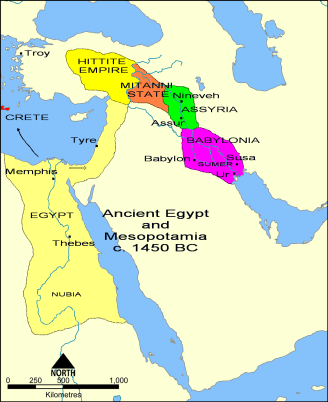 In Smith’s dictionary of the Bible, Shur is identified as follows:
“(a wall), a place just without the eastern border of Egypt. Shur is first mentioned in the narrative of Hagar’s flight from Sarah. (Genesis 16:7) Abraham afterwards “dwelled between Kadesh and Shur, and sojourned in Gerar.” (Genesis 20:1) It is also called Ethami. The wilderness of Shur was entered by the Israelites after they had crossed the Red Sea. (Exodus 15:22 Exodus 15:23) It was also called the wilderness of Etham. (Numbers 33:8) Shur may have been a territory town east of the ancient head of the Red Sea, and from its being spoken of as a limit, it was probably the last Arabian town before entering Egypt.” (Smith’s dictionary 1901)
In Hasting’s dictionary of the Bible, Havilah is identified as follows:
“It has been suggested that it formed the NE part of the Syrian Desert, but it may with greater probability be identified with central and north east Arabia.” (Hasting’s dictionary of the Bible, P.333).
And in the definition of the word “Gold”, he says:
“…the main sources of it being Ophir, Tarshish and Sheba. Another Gold producing country was Havilah. Of the localities, Havilah and Sheba were Arabian.” (Hasting’s dictionary of the Bible, P.619).
In Holman’s dictionary of the Bible, Havilah is identified as follows:
“Place name meaning, “sandy stretch.” Biblical name for the sand-dominated region to the south covering what we call Arabia without necessarily designating a particular geographical or political area. The river from Eden is described as flowing “around the whole land of Havilah” (Genesis 2:11), a land noted for gold and other precious stones. The Table of Nations lists Havilah as a son of Cush or Ethiopia, showing Havilah’s political ties (Genesis 10:7). Some Bible students think the name is preserved in modern Haulan in southwest Arabia. Havilah is also mentioned in the table of Nations as a son of Joktan, the grandson of Shem (Genesis 10:29). The descendants of Ishmael, Abraham’s son, lived in Havilah (Genesis 25:18). Saul defeated the AMālekites from “Havilah as you go to Shur, which is east of Egypt” (1Samuel 15:7), a description whose meaning Bible students continue to debate. Some seek to change the Hebrew text slightly. Others look for a Havilah further north and west than Havilah is usually located. Others talk of the fluid boundaries of the area. Thus Havilah refers to an area or areas in Arabia, but the precise location is unknown.” (Holman’s dictionary of the Bible 1991).
Other sources like (Smith’s dictionary 1901), (Encyclopedia Biblica 1899) and (Easton’s 1897) suggested that there could be more than one place with the name Havilah. Checking old studies by Rev. Archibald Henry Sayce (1846-1933), who was a pioneer British Assyriologist and linguist, he held a chair as Professor of Assyriology at the University of Oxford from 1891 to 1919. In his work: “The races of the old testament” back in (1891) he says:
“The South Arabian tribe of Sheba spread far to the north, through the sandy deserts of Havilah, and founded a kingdom which came into conflict with Assyria in the days of Tiglath-pileser and Sargon.” (A.H.Sayce, Races of the Old Testament)
“The tribes and districts of South-eastern Arabia traced their descent to Joktan. Among them we find Hazarmaveth, the modern Hadhramaut, Ophir, the famous sea-port and emporium of the goods of the further east, Havilah the sandy region, compassed by the river Pison (Gen. ii.II), and occupied by the sons of Ishmael (Gen. xxv. 18), and AMālek (i Sam. xv. 7), as well as Sheba, the Saba of the native inscriptions, whose ancient capital is now represented by the ruins of Mareb in the south-western corner of Arabia.” (A.H.Sayce – Races of the old testament – P.65)
And he says in his work “Early Israel and the Surrounding Nations” in (1899):
“The Ishmaelites were merchants and traders. They lived on the caravan-road which brought the spices of southern Arabia to Canaan and Egypt, and the trade was largely in their hands.” (A.H.Sayce – Early Israel and the Surrounding Nations – chapter III)
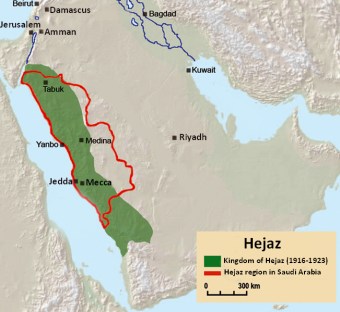 The problem with Sayce’s studies is that they lacked modern science elements, like the use of satellites, underground imaging and tracking the dried out river valleys. Modern studies by “Juris Zarins”, who is an archaeologist and professor at Missouri State University specialized in the Middle East, he has extensive experience in archaeological fieldwork in Saudi Arabia, Egypt, Oman, and Yemen, suggested Hejaz mountains to meet Havilah’s description. Hejaz is defined primarily by its western border on the Red Sea, it extends from the Gulf of Aqaba to Jizan in the far south-west of Saudi Arabia and directly north of the border with Yemen, as demonstrated on the second map. This region includes both the Cradle of Gold at “Mahd Al-dahab” which is the leading gold mining area in the Arabian Peninsula, located in Madinah province, and it also includes a possible source of the “Pishon River” – that has been speculated to refer to a now dried-out river formerly flowing 600 miles (970 km) northeast to the Persian Gulf via “Wadi Al-Batin” system. Archaeological research led by “Farouk El-Baz” of Boston University indicates that the river system, now prospectively known as the Kuwait River, was active 2500–3000 BC. Bdellium plants are also abundant in Hejaz.
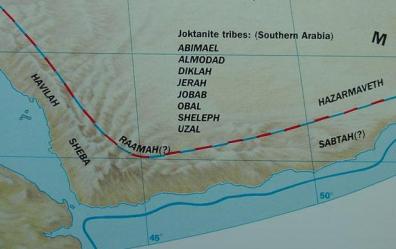 This map demonstrates an approximate location based on the previous data for the place of Havilah. The region of South West Arabia (Yemen today) has the kingdom of Sheba and the region called Hazarmaveth (Arabic: Hadhramaut). In Genesis Havilah is described as a land of gold, bdellium and precious stones. The Queen of Sheba brought Solomon much gold, spices and incense (resins) and precious stones (1 Kings 10:1-13). Genesis also mentions that Havilah was a son of Joktan, and his brothers are Sheba and Hazarmaveth (Genesis 10:26-30), which are localities associated with Yemen in south west Arabia. So if Shur is a place between Palestine (Philistia) and Egypt, and if Havilah is a place in Arabia, and most probably from the above descriptions, starts somewhere between the south west corner and central west Arabia, then the area where Ishmael and his offspring dwelt couldn’t be but “Hejaz”, which is the west half of the country called today Saudi-Arabia, and so Paran most probably is a place in this area.
The Egyptian historian “Al-Maqrizi” (1364-1442 A.C.), gave full description for all the places named Pharan in his most important book “Al-Mawaiz wa al-’i’tibar fi zikr al-khitat wa al-’athar” or “Lessons and considerations in mentioning the tracks and signs”, which was translated into French by “Urbain Bouriant” as (Description topographique et historique de l’Égypte – Paris, 1895–1900 A.C.), he said:
“The city of Pharan: is a city at the shores of Qalzam sea (Red sea) and it’s among the cities of the “Amaleek” (i.e. AMālekites) over a hill between two mountains, and in the two mountains there are a lot of holes, uncountable, filled with dead corpses, and from there to Qalzam sea there is only one station, and it’s called at that place: the shore of Pharan sea. It’s the sea in which God drowned pharaoh, between Pharan city and the “Israelites’ wanderings in the wilderness” there are two stations. And it is mentioned also that Pharan is the name of the mountains of Makkah or the mountains of Hejaz, and this is the one mentioned in Torah. Verifications show that Pharan and Tor are two towns in Upper Egypt and that they are different from the ones mentioned in the Torah. It is said that Pharan is the son of Amr the son of Amleek (AMālek) and that he’s the one to whom the mountains of Makkah are ascribed. People say: Pharan mountains, and others say: Pheran mountains, and the city of Pharan has been among the cities of Madian until today, it’s full of fruitful palm trees from which I ate and there is a big river in it, and it’s a site of ruins by which the Arabs pass.” [Al-Maqrizi, “Lessons and considerations in mentioning the tracks and signs”].
Some people, in their search of the place, claimed that Ishmael lived and died in Egypt. Others claimed that the Arabs are not the descendants of Ishmael. Well, these are the worst claims ever, as the Egyptian history is known way far before Abraham through Egyptology, and never was it found mentioned anywhere in the Egyptian history that Ishmael immigrated and settled in Egypt, and formed a nation there, or that the Egyptians are his descendants. Remember that Allah promised Abraham to make of Ishmael a great nation in Genesis and how Ishmael’s seed was multiplied exceedingly through his twelve sons. The tribes of the two sons: Nebajoth and Kedar, seem to have acquired an ascendancy over the rest, and that’s why the Arabs are sometimes referred to after one of them. This is exactly like the entire nation of Israel is sometimes designated Judah from the superiority in numbers of this tribe. “Eusebius Sophronius Hieronymus” known as “Jerome” (347-420 AD) who was recognized by both the Catholic Church and the Eastern Orthodox Church as a saint, testified for this in his commentary on Jeremiah: he described Kedar as a region of the Arabian desert, where the Ishmaelites dwelt, and in his commentary on Isaiah, he observed Nebajoth as one of the sons of Ishmael after whose names the Arabian desert was called.
“Joseph Ibn Matityahu” (37-100 AD), the famous Roman-Jewish historian who lived in Galilee in north Palestine testified for the same truth in his book: “Antiquities of the Jews” where he says: “Now when Sarah had completed her ninetieth, and Abraham his hundredth year, a son (Isaac) is born unto them, whom they forthwith circumcise on the eighth day, and from him the Jews derive their custom of circumcising children after the same interval. But the Arabians administer circumcision at the close of the thirteenth year, for Ishmael, the founder of their nation, the son of Abraham by his concubine, was circumcised at that time of life” (Antiquities of the Jews, chapter 12). Ibn Matityahu also said: “That he (i.e. Abraham) left to Ishmael and to his posterity, the country of Arabia, as also to his sons by Keturah, Troglodytes: and to Isaac, Canaan.” (Antiquities of the Jews, chapter 9).
Also “Origen Adamantius” (185 – 254 AD) who is regarded as one of the Church Fathers and one of the most distinguished writers of the early Church testified for the same truth in his writings where he says: “The natives of Judea generally circumcise their children on the eighth day, but the Ishmaelites who inhabit Arabia universally practice circumcision in the thirteenth year.”
It is evident beyond doubt from what the earliest knowledgeable historians and church fathers wrote that Arabs are the descendants of Ishmael, the son of Abraham, and that they have dwelt in Arabia since Ishmael moved with his mother Hagar to Pharan. Hence, we can now understand that the opinion stating that Paran is in Sinai, contradicts the historical solid fact that Ishmaelites dwelt in Arabia. Moreover, read Deuteronomy where it says: {33:1} And this [is] the blessing, wherewith Moses the man of God blessed the children of Israel before his death. {33:2} And he said, The LORD came from Sinai, and rose up from Seir unto them, he shined forth from mount Paran, and he came with ten thousands of saints: from his right hand [went] a fiery law for them.
The verses are obviously referring to three distinctly different places (Sinai, Seir and Paran), so it is illogical to say that one of them is located inside the other. This was reassured in Numbers verse {10:12} that says: “And the children of Israel took their journeys out of the wilderness of Sinai, and the cloud rested in the wilderness of Paran.” So it doesn’t take a rocket scientist to understand that Paran couldn’t be a place inside Sinai.
Furthermore, logically speaking, if I wanted to ask about the place where any famous historical figure lived, the most correct information I shall get would be from this figure’s people or tribe and offspring, for they would be the ones most knowing of his history. If I wanted to learn about Queen Elizabeth, where she lived and where she was buried, I would ask the English people, not the Chinese. Since Ishmael P.B.U.H. was the father of Arabs and one of the most famous figures in their history, therefore the Arab tribes are the ones who are most knowing of the place where he lived, not anyone else. As inherited by all Arab tribes, even before the advent of Islam by centuries, Ishmael lived and died in the place they call “Makkah,” and he built the sacred mosque there with his father Abraham at the sanctuary called “Bakkah.”
Download the Complete Book:
IMME, ISBN:9789779027395
Written by: Ehab Shawky
For complete understanding, kindly read my previous posts: The Prophecy of Isaiah, The Prophecy of Habakkuk, The Man In the “Song of Songs” & The Final Testament.
For more information about Paran, kindly visit:
https://en.wikipedia.org/wiki/Desert_of_Paran#Biblical_Paran
Discover more from Islamic Methodologies Made Easy
Subscribe to get the latest posts sent to your email.
 Islamic Methodologies Made Easy