How to know whether a person is a fraud or not has always been a complicated issue that needs a lot of investigation. Trying to imagine how such investigations were carried out 1400 years ago is surely something extremely hard. Luckily enough, we have an example that has been lying recorded in the book of Bukhari for over 1150 years. It’s related to a Muslim from the first generation, and his dialogue with Emperor Heraclius himself.
Abu-Sufyan Ibn Harb was a former idolater and a notable leader among Quraish, the Prophet’s tribe. He was one of the fiercest enemies of Islam and Prophet Muhammad P.B.U.H. He was also one of the pagans’ leaders at the battle of ‘Uhud in which the Prophet was hurt badly. Later on, he embraced Islam and became one of the companions and a devout Muslim after 20 years of waging war after another against the Prophet, and plotting to kill him at every opportunity. Companion ‘Abdullah Ibn ‘Abbās reported the story of his faith as he had heard it from him saying:
“Abu-Sufyan Ibn Harb informed me that Heraclius sent a messenger to summon him while he was accompanying a caravan from Quraish. They were merchants doing business in Sham during the time when the Prophet held a truce with the pagans of Quraish. So Abu-Sufyan and his companions went to Heraclius at ‘Ilya’ (i.e. Jerusalem). Heraclius summoned them into his court, where he had all the senior Roman dignitaries around him. He called for his translator. Translating Heraclius’s question, the translator said to them, ‘Who amongst you is closely related to that man who claims to be a Prophet?’
Abu-Sufyan replied, ‘I am the nearest relative to him amongst the group.’
Heraclius said, ‘Bring him (Abu-Sufyan) close to me and make his companions stand behind him.’
Abu-Sufyan added, ‘Heraclius told his translator to tell my companions that he wanted to ask me some questions regarding that man (i.e., the prophet), and if I told a lie, they should signal him. By Allah! If I hadn’t been afraid that my companions might label me a liar, I wouldn’t have said the truth about the Prophet. The first question he asked me was, ‘What is the status of his family amongst you?’
I replied, ‘He belongs to a good noble family amongst us.’
Heraclius further asked, ‘Has anyone amongst you ever claimed to be a Prophet before him?’
I replied, ‘No.’
He said, ‘Was anybody amongst his ancestors a king?’
I replied, ‘No.’
Heraclius asked, ‘Do the nobles amongst you follow him or the poor?’
I replied, ‘It is the poor who follow him.’
He said, ‘Are his followers increasing or decreasing?’
I replied, ‘They are increasing.’
He then asked, ‘Does anybody amongst those who embrace his religion become displeased and renounce the religion afterwards?’
I replied, ‘No.’
Heraclius said, ‘Was he ever accused of being a liar before he claimed to be a Prophet?’
I replied, ‘No.’
Heraclius said, ‘Does he break his promises?’
I replied, ‘No, we are at truce with him, but we do not know what he is going to do.’
(Abu-Sufyan explained his last answer saying, ‘I wasn’t able to find any opportunity to say a thing against him except through this answer.’)
Heraclius then asked, ‘Have you ever had a war with him?’
I replied, ‘Yes.’
Then he said, ‘What was the outcome of the battles?’
I replied, ‘Sometimes he was victorious and sometimes we were.’
Heraclius said, ‘What does he order you to do?’
I said, ‘He tells us to worship Allah alone and not to associate any partners with Him, and to renounce all that our ancestors had said. He orders us to pray, to speak the truth, to be chaste, and to keep good relations with our Kith and kin.’
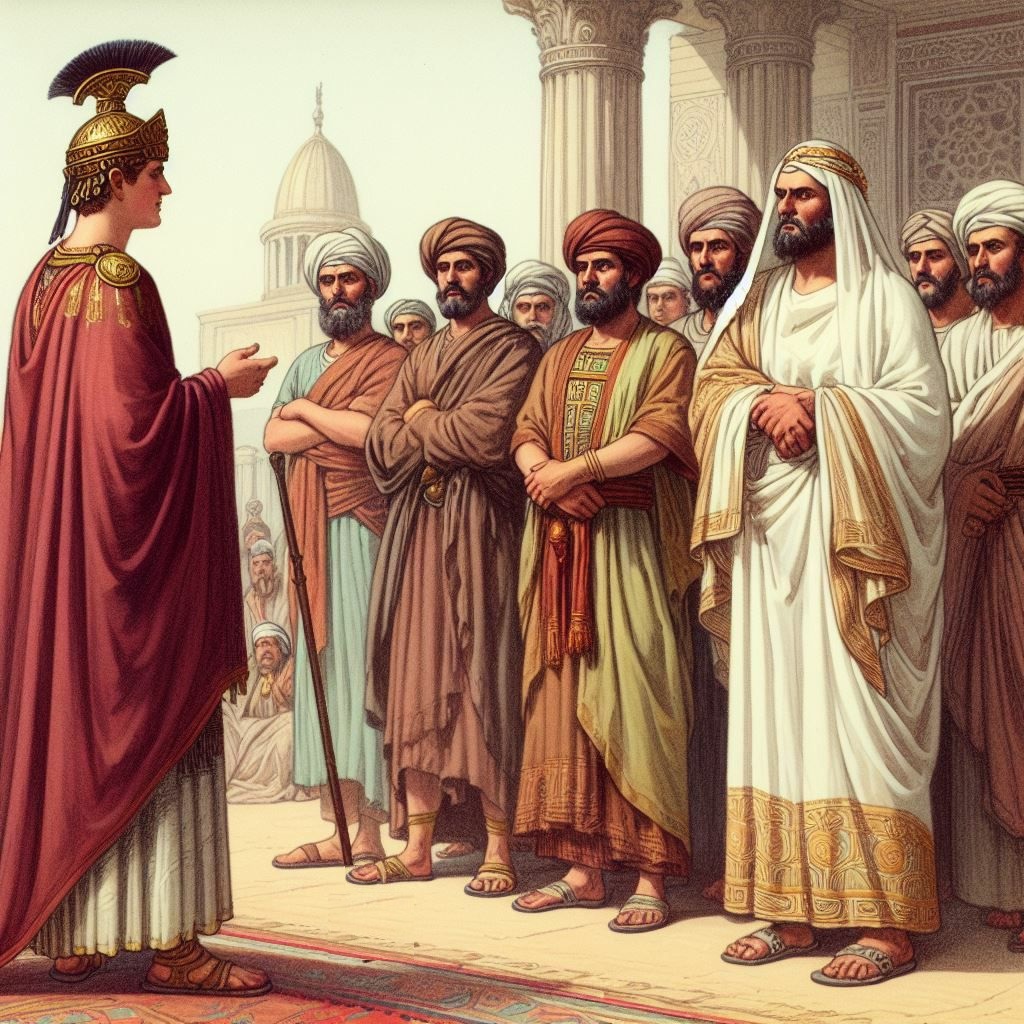
After that, Heraclius asked the translator to convey to me the following: ‘I asked you about his family, and your reply was that he belonged to a very noble family. In fact, all prophets come from noble families amongst their respective peoples. I asked you whether anyone else among you had claimed such a thing; your reply was in the negative. If the answer had been in the affirmative, I would have thought that this man was following the previous man’s statement. Then I asked you whether any of his ancestors was a king. Your reply was in the negative, and if it had been in the affirmative, I would have thought that this man wanted to take back his ancestral kingdom. I further asked whether he was ever accused of telling lies before he claimed his Prophethood, and your reply was in the negative. So I wondered how a person who does not tell a lie about others could ever tell a lie about Allah. I then asked you whether the rich people followed him or the poor. You replied that it was the poor who followed him. And in fact, all the prophets have been followed by this very class of people. Then I asked you whether his followers were increasing or decreasing. You replied that they were increasing, and in fact, this is the way of true faith, till it is complete in all respects. I further asked you whether there was anybody who, after embracing his religion, became displeased and discarded his religion. Your reply was in the negative, and in fact, this is the sign of true faith, when its light enters the hearts and mixes with them. I asked you whether he had ever betrayed. You replied in the negative, and likewise, all prophets never betray. Then I asked you what he ordered you to do. You replied that he ordered you to worship Allah alone and not to associate partners with Him, and he forbade you from worshiping idols and ordered you to pray, to speak the truth, and to remain chaste. If what you have said is true, what he calls for will very soon rule over this place underneath my feet. I expected (from the scriptures) that he was soon going to appear. Still, I didn’t know that he would be from you (Arabs), and if I could reach his city, I would definitely go to meet him. If I were with him, I would certainly refrain from even washing his feet (i.e., a Christian tradition of showing humility and brotherhood attributed to Jesus P.B.U.H.).’
Heraclius then asked for the letter addressed by the prophet, which was delivered by Dihya (the prophet’s companion) to the Governor of Busra, who forwarded it to Heraclius.
Abu-Sufyan then added, ‘When Heraclius read the prophet’s letter, there was a great hue and cry in the Royal Court, so we were escorted out. I told my companions that the matter of Ibn Abi-Kabsha (referring to Prophet Muhammad in an infuriated way) has become so prominent that even the King of Bani-El-Asfar (i.e., the Romans) is afraid of him. Then I started to believe that the Prophet’s call for Islam would prevail soon. Later on, Allah guided me to embrace Islam.’ ” [Recorded by Bukhari].
Bukhari recorded that it was reported by one of the court politicians —who later on embraced Islam— that when Heraclius summoned his councilors, they refused Islam and denied any possibility that the awaited prophet could come from among the Arabs. Consequently, they decided to fight against the spread of Islam and stop Muslims from preaching the new religion at any price. Heraclius agreed with his councilors out of fear for his authority, so he ordered his lieutenants to assemble an army, enter the Arab lands, and attack Madinah. He warned his Ghassanide Arab allies about the new religion. This later on led to a long struggle between Arabs and Romans —then their successors— that continued for centuries. In its course, millions died, mostly among the Arabs and their Muslim brothers from other nations, Syrians, Egyptians, Iraqis, Moors, Turks, etc. This makes me wonder, what would have happened if Heraclius followed his hunch and embraced Islam when it appealed to him? What would have happened if, instead of waging wars, Heraclius had decided to ask the prophet’s emissary about Islam and what it calls for in detail, like other kings did? What would have happened if Heraclius forgot for one moment that he was the king of the strongest empire on earth at that time, and decided to investigate the truth by continuing his intelligent dialogues with the prophet himself?
Although it was Heraclius who made Islam appeal to Abu-Sufyan and proved to him through logical dialogue that Prophet Muhammad wasn’t a fraud, but a true messenger from Allah, he preferred his status as an emperor over being a man who stood for what he believed in. Heraclius died 13 years later in 641 A.D., after Prophet Muhammad passed away by 9 years, and after losing all his battles against Muslims. What he foretold Abu-Sufyan actually happened, and multitudes from the people of Sham embraced Islam. On the other hand, Abu-Sufyan embraced Islam in the year 630 A.D., 2 years before the Prophet passed away. He fought beside the Prophet at the Battle of Hunayn in that same year. He was 70 years old at that time, and he lost an eye in that battle while defending the Prophet. Though older than the prophet by 8 years, he died later on in 652 A.D. at the age of 92. This story makes me believe that it’s not we who get to choose Allah, but He gets to choose us based on something very intimate that only He can see within our hearts.
Written By: Ehab Shawky.
Discover more from Islamic Methodologies Made Easy
Subscribe to get the latest posts sent to your email.
 Islamic Methodologies Made Easy